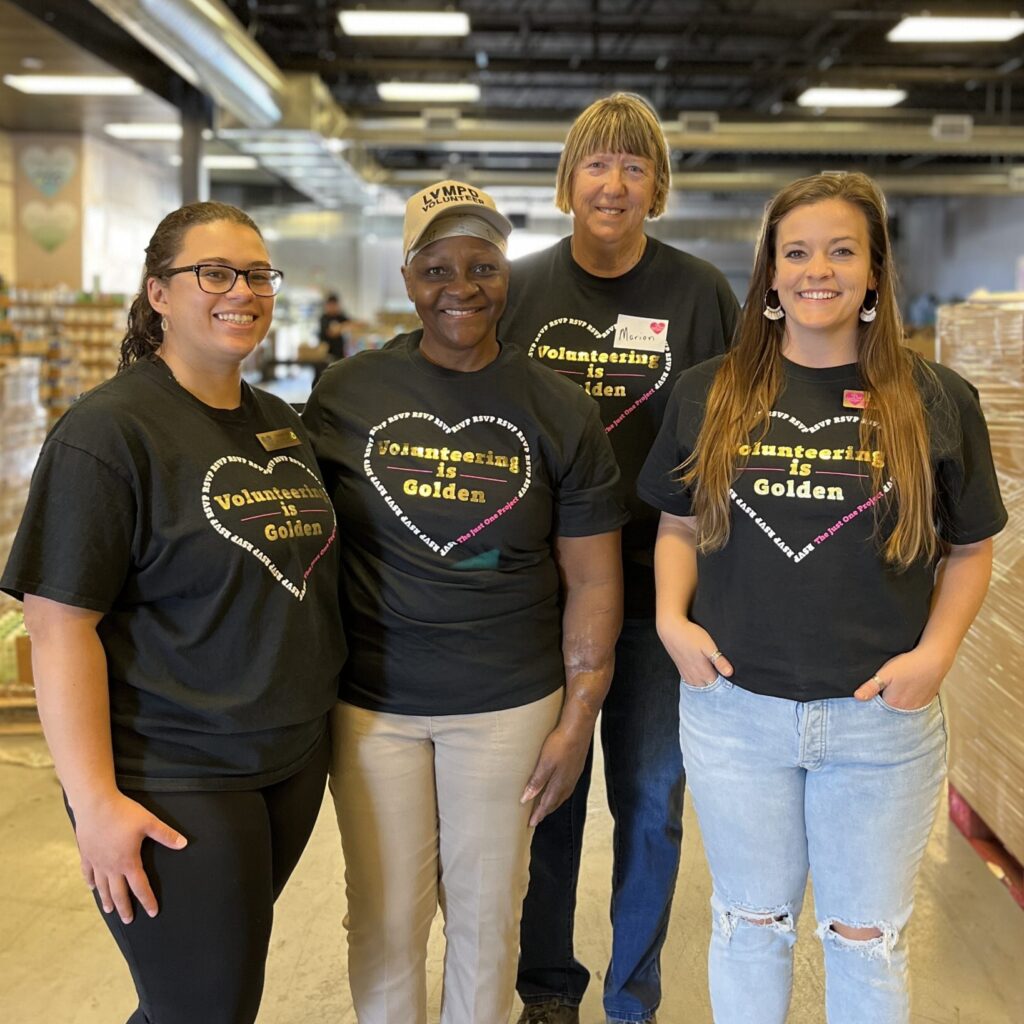
Volunteers help The Just One Project operate food markets, deliver groceries, prepare rescued food, support community events, and extend services throughout Southern Nevada. Opportunities are available for individuals, families, groups, corporate teams, court-appointed volunteers, and adults age 55 and older. During the first half of 2026, 5,053 TJOP volunteers completed 24,506 hours of service, illustrating how volunteer participation becomes part of the infrastructure behind the organization’s programs.
Most people see a food distribution after the tables have been set, the groceries have arrived, and the first cars are moving through the line.
They do not see the work that made that moment possible.
Food must be received and organized. Pallets must be unloaded. Produce must be sorted. Grocery bags must be packed. Routes must be prepared for home delivery. Surplus meals must be portioned while they remain fresh. Clients must be welcomed and guided through each distribution.
At The Just One Project, volunteers participate in that work throughout the week and at Saturday events. Their role extends well beyond assisting at a single event. Collectively, they help TJOP maintain the systems that move food and resources from warehouses, hospitality kitchens, and distribution partners into Southern Nevada communities.
That is the work behind the work.
Volunteer Service Becomes Program Capacity
Nonprofit organizations often describe volunteers as supporters of their mission. That is true, but it does not fully explain their operational value.
Every volunteer hour adds capacity.
A volunteer who packs grocery bags helps prepare a future distribution. Someone who delivers groceries helps TJOP reach a client who cannot leave home. A team sorting rescued food helps preserve prepared meals that must move quickly. Volunteers unloading pallets allow a mobile market to begin serving the community on schedule.
One person may complete one task during one shift. When thousands of people contribute their time, those individual tasks become a working system.
During the first half of 2026, 5,053 volunteers completed 24,506 hours of service with The Just One Project. Those hours supported an organization that operates food markets, mobile distributions, home-delivery services, food rescue, case management, housing programs, and other community initiatives across Southern Nevada.
The number matters because it reveals something that is easy to overlook: large-scale community programs depend on many small, coordinated actions.
Volunteer Opportunities Reflect How TJOP Serves Southern Nevada
The Just One Project does not rely on one form of food distribution. Its Food for All programs include fixed community markets, mobile markets, farmers markets, grocery delivery, and food rescue.
Volunteer opportunities reflect that range.
Pop Up & Give Mobile Markets
Pop Up & Give brings groceries into communities through recurring mobile distributions.
Volunteers help unload pallets, organize food, prepare distribution areas, and hand groceries to community members. The work is physical and highly coordinated. Each station contributes to the pace and order of the event, allowing TJOP to serve a large number of households within a limited period.
For volunteers, this is also one of the clearest ways to see how transportation and location affect food access. Instead of requiring every client to travel to TJOP headquarters, the program brings food closer to the communities being served.
Food as Medicine Farmers Markets
TJOP’s Food as Medicine Farmers Markets focus on access to fresh produce and nutrition-related resources.
Volunteers assist with produce distribution and help maintain an organized market experience. Depending on the event and assigned role, they may also support the distribution of recipes, nutrition education, and health-screening activities provided through the program.
This work helps turn a shipment of produce into a functioning community market where participants can access fresh food efficiently.
Grocery Delivery
Some clients cannot leave their residences to attend a market or food distribution.
Grocery-delivery volunteers bring fresh food directly to their homes. TJOP notes that morning delivery routes generally require two to three hours.
The work may appear straightforward, but the service addresses a specific access barrier. Food can be available within a community while remaining out of reach for someone who cannot travel to receive it.
Delivery closes that final distance.
Food Rescue and Kitchen Preparation
Food rescue operates under strict time constraints.
Surplus food recovered from hospitality properties and other food partners must be sorted, portioned, packaged, and prepared for distribution while its freshness can still be maintained. Volunteers help complete those labor-intensive steps.
Their work supports two outcomes at once: prepared food reaches the community, and usable food avoids disposal.
As TJOP’s Food Rescue Alliance expands through partners such as The Venetian Resort Las Vegas and Caesars Entertainment, dependable volunteer support becomes increasingly important to the recovery process.
Community Markets, Events, and Other Projects
TJOP volunteers also support No-Cost Community Markets, special events, food sorting and packing, administrative projects, and other community initiatives.
The specific task may change according to the program, but the purpose remains consistent: help staff move resources through the organization safely, efficiently, and reliably.
There Is More Than One Way to Volunteer
Volunteer programs work best when people can participate according to their age, schedule, abilities, and reasons for serving.
TJOP welcomes individual volunteers and groups. There is no general minimum age, although volunteers younger than 16 must participate with an adult. The organization also coordinates service for corporate teams, community organizations, court-appointed volunteers, families, and returning volunteers who want to serve regularly.
This range is important because volunteerism is not one uniform experience.
Some people want to spend a morning delivering groceries. Others are looking for a recurring role. Parents may want to introduce their children to community service. Retirees may be seeking connection and purpose. Businesses may want an employee experience that places their team inside a local program rather than at a conventional off-site meeting.
A useful volunteer program creates room for those different forms of participation while still meeting real operational needs.
Volunteering Is Golden
TJOP’s Retired Senior Volunteer Program, known as Volunteering Is Golden, provides service opportunities for adults age 55 and older.
Participants may pack and distribute groceries, promote volunteerism among their peers, and take part in quarterly social and training opportunities. The program is supported through an AmeriCorps grant.
This initiative addresses two community needs through the same structure.
TJOP gains experienced volunteers who contribute to food programs and community outreach. Older adults gain opportunities to remain active, build connections, and participate in purposeful service.
The value moves in both directions.
Corporate Volunteering Can Be Designed Around Real Work
Corporate volunteerism is sometimes treated as a team-building exercise with a charitable theme added to it. TJOP’s Impact on the Go program takes a more practical approach.
Corporate groups participate in custom grocery-packing sessions at TJOP’s headquarters warehouse. Staff provide the supplies, instructions, and guidance. The completed bags or boxes are later distributed to clients in the community.
The experience still gives employees an opportunity to work together outside their normal roles. However, the team-building element is tied to a defined program need.
The groceries are not symbolic.
They are packed for distribution.
That distinction gives the experience value beyond the volunteer session itself. The company receives a shared service opportunity, while TJOP completes work that directly supports future food access.
TJOP can also arrange customized volunteer days for companies whose teams want to participate in farmers markets, distributions, or other hands-on projects. Employees and their families may participate, allowing community involvement to extend beyond the workplace.
What Volunteers Learn by Participating
Volunteer service offers a view of community programs that is difficult to gain from an impact report alone.
A report may state how many pounds of groceries were distributed. A volunteer sees the steps required to move those groceries.
A program page may explain that home delivery reaches people who cannot travel. A delivery volunteer sees why the final route matters.
Food-rescue statistics may quantify meals recovered. A kitchen volunteer sees how quickly that food must be sorted and packed before it can be used.
This perspective does not require volunteers to become experts in food insecurity or social services. It gives them a clearer understanding of how local programs operate and why seemingly simple services require planning, logistics, partnerships, and sustained participation.
That understanding can influence how people continue to engage with their community after the shift ends.
The Value of Returning
A one-time volunteer shift can complete useful work. Regular participation adds something else: familiarity.
Returning volunteers learn the flow of a distribution, understand how a packing station should be organized, and recognize what needs to happen next. Staff spend less time explaining basic procedures, and experienced volunteers can help newer participants understand their roles.
Consistency also helps TJOP plan.
Programs that operate every month require dependable participation every month. Food must be moved whether a volunteer shift falls during a busy season, a school break, or an ordinary weekday.
The most useful volunteer commitment is not necessarily the largest one. It is one that a person or group can realistically fulfill.
For some, that may mean serving once. For others, it may become part of a regular routine.
Both forms of participation matter when expectations are clear and the work is connected to an actual program need.
Volunteer Service Connects TJOP’s Work
The Just One Project describes its work through two principal areas: Food for All and Community Connect.
Volunteers are most visible within food programs, where they can be seen packing groceries, distributing produce, preparing rescued meals, and completing delivery routes. Their contribution also supports the organization more broadly.
When volunteers help operate a food program, TJOP staff can serve more clients and maintain more consistent access points. Food assistance may also become a client’s first connection to other resources available through the organization.
Volunteer service therefore contributes to more than the completion of a distribution. It helps maintain one of the primary ways TJOP meets and stays connected with Southern Nevada residents.
Choosing a Volunteer Opportunity
The best volunteer role is one that fits both the organization’s needs and the volunteer’s ability to participate.
Someone comfortable driving may be well suited to grocery delivery. A person who prefers working with a group may enjoy a mobile market or warehouse-packing session. Corporate teams may benefit from a customized Impact on the Go experience. Adults 55 and older may find a recurring role through Volunteering Is Golden.
Before registering, volunteers should consider:
- How much time they can reliably commit
- Whether they prefer individual or group service
- Whether they are comfortable with physical tasks
- Whether they want to serve once or return regularly
- Whether they need court-appointed service approval
- Whether a child under 16 will participate with them
TJOP provides separate registration options for new and returning volunteers. Groups, corporate teams, and court-appointed volunteers should contact the volunteer team directly so the appropriate arrangements can be made.
A Community Program Is Only as Strong as Its Ability to Operate
The need for food assistance does not automatically create the capacity to provide it.
Food must be sourced, stored, packed, transported, distributed, and delivered. Programs need schedules, equipment, staff, partners, and people willing to complete the work.
Volunteers help close the distance between a resource being available and that resource reaching someone who can use it.
That is their measurable value to The Just One Project.
Thousands of volunteer shifts do not replace professional staff or community investment. They allow those resources to reach further. They turn individual participation into additional operating capacity across programs serving Southern Nevada.
The public may see the market, the delivery, or the completed grocery bag.
Behind each one is the work that made it possible.
Frequently Asked Questions About Volunteering with TJOP
Who can volunteer with The Just One Project?
TJOP welcomes volunteers of all ages and abilities. Volunteers younger than 16 must participate with an adult. Opportunities are available for individuals, families, groups, companies, court-appointed volunteers, and adults age 55 and older.
What volunteer opportunities are available?
Opportunities may include Pop Up & Give Mobile Markets, Food as Medicine Farmers Markets, grocery delivery, food rescue and kitchen preparation, Community Markets, food sorting and packing, special events, administrative projects, and other community initiatives.
Can businesses organize a corporate volunteer day?
Yes. TJOP coordinates corporate volunteer experiences and offers Impact on the Go, a customized grocery-packing program held at its headquarters warehouse. Companies may contact the volunteer team to discuss available group opportunities.
Does TJOP accept court-appointed volunteers?
Yes, but court-appointed volunteers must contact TJOP before registering so the organization can review the service requirements and provide the appropriate instructions.
Can children volunteer?
Yes. TJOP does not have a general minimum age for volunteering. However, anyone younger than 16 must volunteer with an adult.
How can someone register to volunteer?
New and returning volunteers can register through TJOP’s Volunteer Opportunities page. Groups, corporate teams, and court-appointed volunteers should contact the volunteer team directly to coordinate their participation.
Get Involved
Volunteer opportunities are available throughout the week and during designated Saturday events.
Choose an opportunity that fits your time, interests, and abilities, then register through The Just One Project’s volunteer page. Corporate groups, community organizations, and other teams can contact TJOP to arrange a coordinated service experience.
Your shift becomes part of the work that keeps food and resources moving across Southern Nevada.